Energy shocks and oil shortages: who is most at risk?

Gareth Colesmith
Head of Global Macro Research
Not investment advice. Please refer to the risk disclosures at the bottom of the page

1
Disruption in the Middle East has raised the risk of a fresh oil shock, with the Strait of Hormuz again at the centre of global concern.
2
The biggest danger is not a uniform global shortage, but a patchy one, with some countries far more exposed than others.
3
Our analysis suggests parts of Asia and some smaller import-dependent economies look most vulnerable, while the US, China and Japan appear better placed to cope.
Oil shocks can feel like a relic of the 1970s. But recent turmoil in the Middle East is a reminder that global energy markets still depend on a handful of narrow routes, fragile facilities and complex supply chains.
This time, the concern centres on damage to regional energy infrastructure and severe disruption to traffic through the Strait of Hormuz. That slim shipping lane carries a large share of the world’s oil and liquefied natural gas. When it slows or closes, the effects are not limited to the Gulf; they spread through fuel markets, trade flows and national economies.
While other sources of energy are growing in significance, oil is still deeply woven into modern life. It powers transport, supports manufacturing and helps move goods through the global economy. When supply is disrupted, the result is not just higher prices at the pump. In more severe cases, shortages can start to affect freight, aviation, industry and everyday business activity.
The biggest risk is not a universal shortage, but a highly uneven one.
Source: Insight and Bloomberg, as at 30 September 2026.
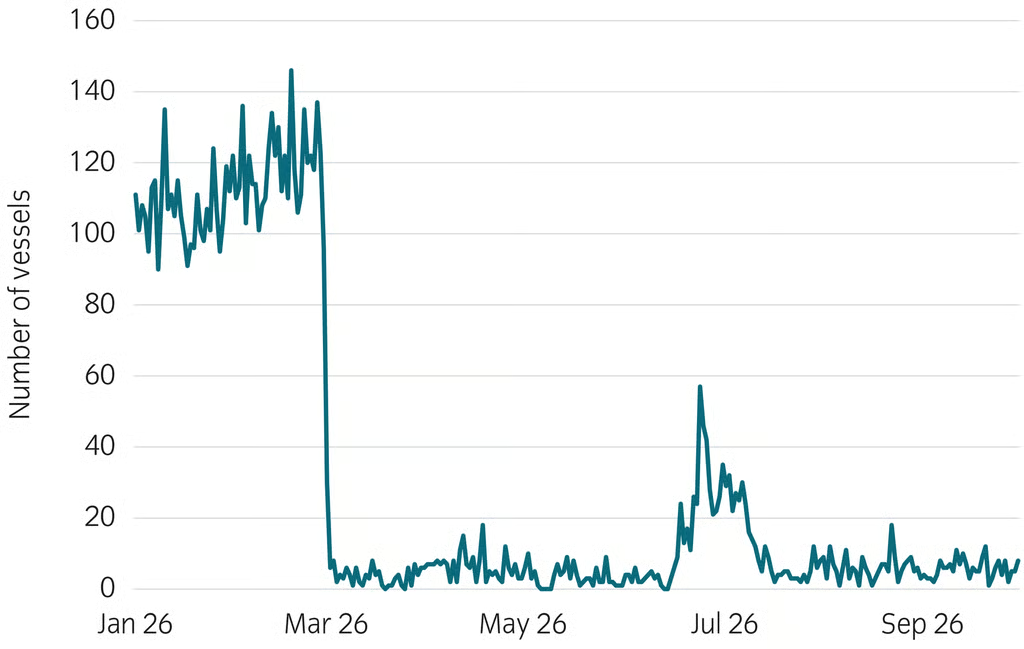
Traffic through the Strait of Hormuz is very limited
The significance of the current shock lies in both scale and timing.
The Strait of Hormuz normally handles roughly a fifth of global oil and gas flows. Few routes matter more. If supply through it is disrupted for a prolonged period, the rest of the world cannot easily replace that volume overnight.
There is also less of a cushion than many assume. Global oil inventories have already been falling, helped in part by the use of strategic reserves. Those stockpiles can soften a shock, but only for so long. If disruption persists, markets can become more fragile and more volatile.
There is another complication too: oil is only part of the story. Countries do not just need crude. They need the right fuel products, such as petrol, diesel, jet fuel and liquefied petroleum gas. A country may have access to crude oil, but still face problems if it lacks enough refining capacity or depends heavily on imported fuels.
That is why a serious energy shock is rarely neat. The weak points tend to show up in bottlenecks, not just in headline supply numbers.
Why this shock matters
Source: Insight calculations, as at 15 June 2026.
Our analysis suggests India, Thailand and Chile are most at risk
India
Thailand
Chile
Philippines
Peru
New Zealand
Taiwan
Korea
Switzerland
Mexico
Australia
Japan
UK
EU
Turkey
Nigeria
Canada
Norway
China
USA
Total oil and products
93
202
165
Net exporter
49
201
119
131
96
Net exporter
Net exporter
128
Net exporter
Days net import cover
Refinery coverage
98%
88%
45%
36%
85%
15%
114%
108%
32%
59%
24%
88%
80%
97%
64%
93%
75%
100%
94%
87%
16.3
15.7
13.2
12.5
11.3
10.9
10.7
10.4
9.8
7.9
7.8
6.5
3.7
3.8
2.9
2.2
2.1
1.5
1.8
1.0
Overall risk
To understand who is most exposed, our analysis focused on three areas: stock levels, refining capacity and reliance on imported fuel products. This is because vulnerability can take different forms. One country may have low reserves, another may depend too heavily on imported diesel, and a third may have enough crude but not enough refining capacity to turn it into the fuels its economy actually uses.
Looking at those factors together gives a more useful picture than simply asking who imports the most oil.
India stands out as one of the most exposed major economies. Along with crude oil dependence, our analysis suggests the risks stretch across several parts of the fuel system, including refined products. That makes India more vulnerable than countries where the pressure is narrower or easier to manage.
Elsewhere in Asia, Thailand, the Philippines, Taiwan and South Korea also appear vulnerable, but the reasons differ. Some rely heavily on imported crude. Others look more exposed because they depend on imported fuels such as diesel, jet fuel or naphtha.
Australia and New Zealand also deserve attention. Neither faces the same scale of risk as some larger Asian economies, but both are highly dependent on imported refined products. Australia appears especially exposed to diesel shortages over time, while New Zealand looks more at risk in fuels such as petrol and jet fuel.
In Latin America, Chile also appears vulnerable in our analysis, again reflecting a mix of import dependence and product-specific pressure points.
The countries we believe are most at risk
Not every country faces the same level of strain.
The US appears to be in the strongest position overall. Domestic production is a major advantage, and the country is also a significant energy exporter. That does not make it immune to price swings, but it does leave it better placed than most to cope with physical disruption.
China also looks relatively resilient, largely because of its large stockpiles. Japan appears better prepared too, helped by deep reserves and a more active state role in energy planning and supply management.
Europe sits somewhere in the middle. It does not appear to face the same broad system-wide risk as some Asian economies, but that should not be mistaken for safety. The region’s vulnerabilities look narrower and more product-specific.
The UK is a good example. It remains dependent on imported jet fuel, even though alternative supplies have helped reduce immediate pressure. Across the wider EU, the risk seems more likely to show up in local bottlenecks than in a sweeping region-wide shortage.
Where the risks look lower
The world may not run out of oil, but some countries could still face serious disruption if specific fuels become hard to source.

The real lesson is that this is unlikely to be a single, global story.
The world may not run out of oil, but some countries could still face serious disruption if specific fuels become hard to source. A diesel shortage can hit road transport and farming. A jet fuel shortage can affect airlines and freight. LPG shortages can disrupt heating and cooking in some places.
That makes this oil shock important not just for energy markets, but for policymakers, businesses and investors trying to understand where the strain will appear first.
Why uneven shocks matter most
In our view, countries with strong reserves, domestic production or better control over supply chains look more capable of coping. Others, especially those dependent on imported crude or refined fuels, may come under much greater pressure if disruption drags on.
That is the key message from our analysis: the biggest risk is not a universal shortage, but a highly uneven one. And in moments like this, uneven shocks can be just as damaging as global ones.
The pressure may not be shared equally

Gareth Colesmith is Head of Global Macro Research. He is responsible for Insight’s macro research function, overseeing internal macro, economics and politics research for the benefit of the investment team.